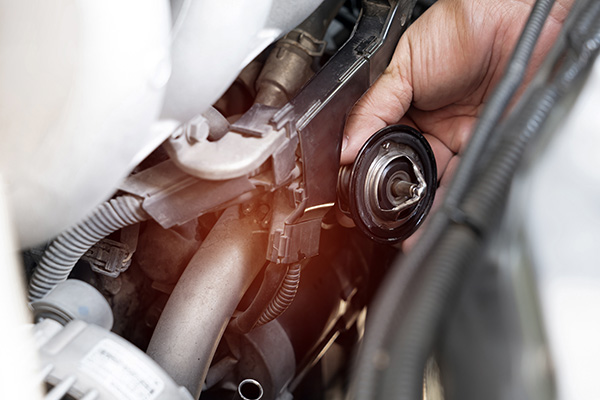
Coolant leaks around the water pump and thermostat housing are a familiar problem on a number of Volkswagen engines. They often start with a small amount of dried coolant residue or a reservoir that needs occasional topping off, then become more noticeable as the seals and housing continue to age.
These components live in a difficult part of the engine compartment. They handle hot coolant, system pressure, vibration, and thousands of heating and cooling cycles. Once a housing begins to distort or a seal loses its ability to hold pressure, coolant starts finding its way out.
Plastic Housings Take a Beating From Engine Heat
Many Volkswagen cooling systems use composite or plastic thermostat housings and water pump assemblies. These materials reduce weight and let complicated coolant passages fit into tight spaces, but they still age after years of exposure to engine heat.
Repeated heating and cooling can make the housing harder and more brittle. Small distortions can also prevent the sealing surfaces from sitting perfectly flat. A leak may start around a gasket or O-ring even though the housing itself does not have an obvious crack. As the problem progresses, the plastic can eventually split or develop a more visible leak.
Seals and Gaskets Lose Flexibility Over Time
The water pump and thermostat housing rely on rubber seals to keep pressurized coolant inside the system. Those seals need enough flexibility to stay tight as the engine components expand when hot and contract after shutdown.
After years of heat exposure, the rubber can flatten, harden, or shrink. Coolant then begins seeping around the sealing surface. At our shop, we often find dried residue around the housing before enough coolant is lost to leave a large puddle. That early evidence is worth paying attention to because the leak rarely gets smaller on its own.
Water Pump Seals Can Leak Even if the Pump Still Works
A water pump can circulate coolant normally and still leak. The internal shaft seal can wear before the pump motor or impeller has failed, depending on the particular Volkswagen engine and pump design.
That means you may have no overheating, bearing noise, or drivability symptoms at first. The only clue might be a falling coolant level or residue around the pump assembly. During an inspection, we look for leakage around the pump and nearby connections instead of assuming a pump is healthy simply because the engine temperature is still normal.
Coolant Residue Can Help Us Trace the Source
Volkswagen coolant leaks do not always drip straight onto the ground. Coolant can run along the engine, transmission housing, brackets, or splash shields before becoming visible underneath the vehicle.
Once coolant dries, it can leave a crusty or chalky residue around the source. We trace that residue back to the highest fresh area and pressure-test the system when needed. This matters because hoses, fittings, oil cooler connections, and expansion tanks can all leak nearby. Replacing a thermostat housing without confirming the source can leave the original leak untouched.
Thermostat Problems Can Show Up With or Without a Leak
The thermostat regulates coolant flow through the radiator so the engine can reach and maintain the correct operating temperature. If the thermostat sticks open, the engine can warm up too slowly, and cabin heat may feel weak. If it sticks closed or coolant flow becomes restricted, the engine can overheat.
On some Volkswagen engines, the thermostat and water pump are packaged closely together or incorporated into a larger cooling module. That means a housing leak and a temperature-control problem can appear at the same time. We evaluate both coolant loss and actual temperature behavior instead of assuming every housing leak means the thermostat itself has failed.
Low Coolant Can Turn a Small Leak Into a Bigger Problem
A slow leak may not affect the temperature gauge immediately. The system can lose small amounts of coolant for weeks before the level finally drops far enough to interfere with circulation.
Once air enters the cooling system, heater output can become inconsistent, and engine temperature can become harder to control. Regular maintenance gives us a chance to notice a falling coolant level or early seepage before overheating begins. If the coolant warning appears repeatedly, topping off the reservoir is not a long-term fix. The source needs to be found.
Correct Coolant and Proper Filling Are Important After Repair
Volkswagen cooling systems require the correct coolant specification. Mixing incompatible coolant types can reduce corrosion protection or create deposits that interfere with cooling-system performance.
The system also needs to be filled and bled properly after a pump or thermostat repair. Trapped air can cause poor heater performance, unstable coolant levels, or temperature problems that make it seem like the repair did not work. We use the correct fluid and make sure the system is circulating properly before the vehicle goes back on the road.
Get Volkswagen Cooling System Service In Kearny, NJ, With Autobahn Auto Repair
If your Volkswagen is losing coolant, showing dried residue near the water pump or thermostat housing, or running hotter or colder than normal, Autobahn Auto Repair in Kearny, NJ, can inspect the cooling system and find the source.
Schedule a Volkswagen cooling-system check before a small housing or water pump leak develops into an overheating problem.
